
Inside the chapel, between tradition and modernity | The Buren room
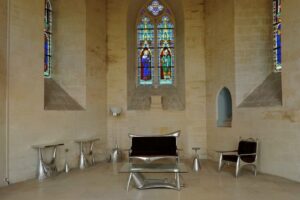
The room called « Buren » hosts wonderful baptismal fonts from the 13th century, coming from the cathedral of Morcourt-sur-Oise. Facing them are two recumbent effigies made of white marble, where lay Léon Dru and his wife, the previous owners of Vez. Léon Dru, born in 1836, was an engineer to whom we owe numerous artesian wells in Paris, Algeria and Russia. An artesian well is a well from which the water flows out naturally. These allowed for a cleaner and cheaper water supply, originating from aquifers. When he died, Léon Dru gave the French state a substantial amount of money which enabled it to buy the castle of Azay-le-Rideau, as well as two paintings by Jean-Siméon Chardin that are currently kept in the Louvre.
Find out more
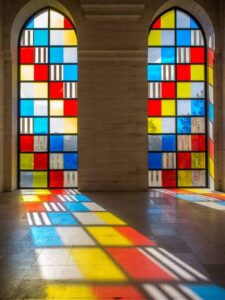
In 2005, Daniel Buren worked on the two large stained glass windows of the chapel. By integrating the characteristics of the place into his own artwork, Buren attempts to invert the traditional vision that links the artwork to its space of exhibition. This is what he calls work in situ. With this artwork, Buren chooses to repeat the same pattern, by alternating vertical stripes. This playful creation on lights and lines offers a creative and modern perception of the chapel. Besides, Buren echoes the art of stain glasses with his work – an art and craft practiced for more than a thousand years and mostly seen in religious buildings.
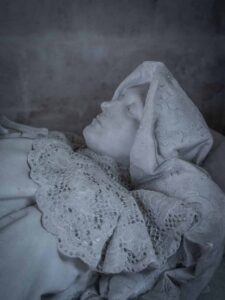
Emmanuel Frémiet, the sculptor of these lying figures in marble, is mostly known for his animal sculptures. He notably created the horses and dolphins of the Paris Observatory’s fountain in 1870. State commissions helped him gain recognition: he sculpted the first equestrian statue of Joan of Arc, located on the Pyramides square in Paris, as well as the one of Saint Michael killing the dragon, located on the tip of the Mont-Saint-Michel’s bell tower. Here, his work is typically medieval, although one can note the outfit is that of a Cossack (a Russian cavalryman), echoing his numerous stays in Russia.
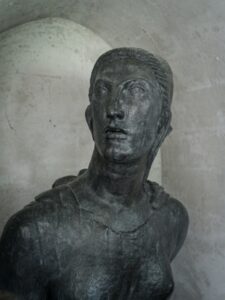
This monumental bronze art piece by Antoine Bourdelle represents Victory. It was created, as were the other allegories exhibited outside, for the equestrian statue of General Alvear in Buenos Aires. Created for the centennial of Argentina’s independence, this statue was to celebrate one of the heroes of Argentina's independence. General Carlos Maria de Alvea, who died in 1852, was an important actor of Latin America’s independence. His statue follows the tradition of artworks from Antiquity to the Renaissance, thereby showing the continuous inspiration from Antiquity in Bourdelle’s work.