

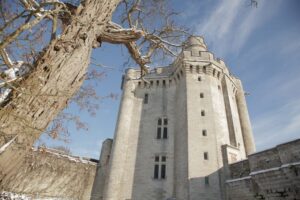
The Dungeon and its fortifications
From here, you can look at the Dungeon. There is evidence that Vez existed as a village as early as the 1st century before Christ, but the Dungeon as you currently see it was built during the 14th Century. It was erected during the 100 Years War. This conflict inflicted a lot of damage to the region, and enemy incursions prompted the lords to strengthen their defence just north of Paris. It was then that Vez was turned into the fortress you see today.
The Dungeon stands 27 meters tall! It served multiple purposes in the 14th century: it served as an observation point, and in case of an attack, as a shooting station. It was also the local lord’s residence. It is flanked by five solid masonry cylinders on its sides, and even though you can’t see it from outside, its walls are 2 meters thick.
All the way up, you can see what we call archer slits: these are thin vertical apertures in the walls. They allowed archers to aim at their enemies to protect the dungeon. If you look under the archer slits, right under the upper terrace, you will see stones in the shape of inverted stairs. These are used to support a tiny extension in the terrace floor, and in there are holes through which the dungeon’s walls can be seen. These holes were used to drop stones or burning material onto anyone who would stand at the foot of the dungeon. The inverted stair-shaped stones are named “stone corbels”, and the holes themselves “machicolations”.
Finally, on the upper level of the Dungeon, you can also admire animal heads gushing from the Dungeon. They are called gargoyles. Despite their threatening appearance, their only function is merely to evacuate rain water away from the wall.
Lower, at the ramparts, doors lead from the Dungeon to raised walkways. Those are called curtain walls, and they allow a garrison to deploy quickly on both fronts of the Dungeon that are accessible to the enemy.
With such a fortification device, a troop of merely fifty men could hold against a small army for a few days. As such, the castle of Vez was one of multiple strongholds that formed a wide defensive front, along with Coucy-le-Château, La Ferté-Milon, Pierrefonds, and Montépilloy.
To continue your visit, head directly towards the “C” marker on the map.