
Welcome to the Dungeon of Vez (introduction by Francis Briest)
Welcome to the Dungeon of Vez.
We are pleased to welcome you in an outstanding monument that is both filled with history, and open to the future!
Vez was awarded France’s prestigious “Historical Monument” label as early as 1906. This is partly because the Dungeon was built during the Middle Ages. Vez’s geographical location provided multiple strategic advantages from a military standpoint, which made it an important stronghold and landmark for several centuries.
This guide offers an overview of Vez’s History, and comments its architecture in relation to the different events that shaped it.
Also, since the 1980s, the Donjon has been home to contemporary art, and more particularly to sculptures and monumental art installations. If you would like to learn more about the art that you see during your visit, please click on “Find out more” as you follow the guided tour.
On behalf of everyone who works at Vez, and on behalf of the artists, I would like to thank you for your visit and wish you a very nice tour.
Find out more
This courtyard is called the « Cour Antoine Bourdelle ». It was designed as a meeting point between nature and sculpture. The artist’s bronze statues are displayed in a garden of apple trees planted in what we call “espalier” shape. This ancient agricultural practice controls the growth of woody plants by tying them to a frame, and cutting them accordingly. Basically sculpting them… The garden was created by a landscaper called Stéphane Ducoux in the year 2000.
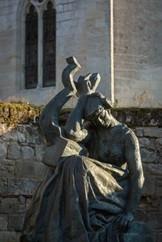
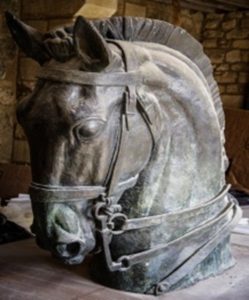
Antoine Bourdelle is a French sculptor born in 1861. A precursor of 20th century monumental sculpture, Antoine Bourdelle was a pupil of Auguste Rodin and then, in turn, master to Giacometti. There is a museum entirely dedicated to his work in Paris. At the end of the 19th century, he developed a “romantic style” in reaction to the evolution of sculpture, which had become too expressive in his view. He searched for order, harmony and moderation in his work and was very inspired by sculptures from Antiquity.
You may notice the iron pedestal under Sappho, which rests on wheels. It is a creation by Jean Tinguely, another artist and sculptor, born in Switzerland, and famous for his “animated machines”.
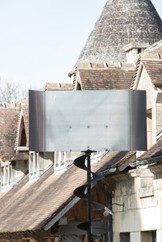
Also in this courtyard is the Windmill by Vassily Takis. Born in 1925, Takis is a Greek artist who became interested in kinetic art very early on. Kinetic art is the art of movement in all its forms. Wind, of course, moves sculpture’s shapes. But the artist also focused on light signals and magnetic fields as a source of movement. Being monumental, his sculptures are purposely designed to interact with their surroundings, bringing a feeling of futuristic strangeness to the places they inhabit.