
When the Middle Ages meet with contemporary art
Following the tradition of the architectural and ornamental programs of the castles, Francis Briest brought together the greatest artists to decorate the rooms of the dungeon, the chapel, the courtyards and the gardens. The creators exhibited at Vez continue the work of their predecessors, drawing inspiration from their times. Alongside the recumbent figures of Frémiet or under the framework of Gustave Eiffel, they thus walk in the footsteps of the counts, dukes and kings, making Vez not just a site bringing together works of art, but a site that becomes a work of art itself. The promotion of the artwork testifies to this enlightened desire, not to make eras and styles coexist, but to make the premises part of the dynamics of the history of art.
As you will have understood, the Dungeon of Vez is a high place in the history of Valois, and a site filled with history. But it is also a temple of artistic creation, a stronghold of modern sculpture. Over a thousand years of art and architecture rub shoulders here, from sculpted stones of the Middle Ages to daring combinations of contemporary art, offering a panorama of centuries in Vez for contemplation.
Find out more
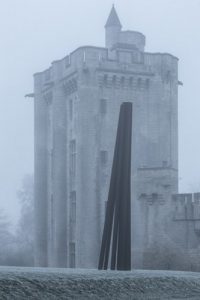
Bernar Venet, born in 1941, is an avant-garde artist of conceptual art. It is an art that favours the idea or the concept of a work over its aesthetic character. Venet's work questions the relationship of art with landscape and architecture. The work 9 oblique lines exhibited here invites the gaze to wander off in the ether. By fitting into the perspective of the dungeon which looms in the background, the monumentality and verticality of the work are accentuated.
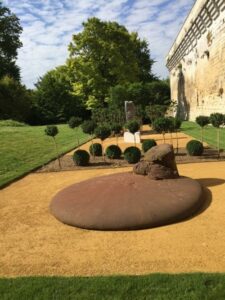
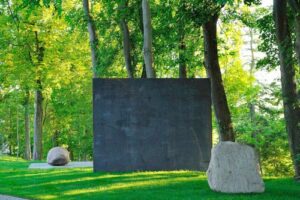
Vez is hosting a work by South Korean artist Lee Ufan. This sculpture links nature to human consciousness through the confrontation of the steel plate, a metaphor of industrialized society, with stone, the symbol of nature. This meeting between natural and industrial elements, and the relationship that results from it, is the central concept of his creations. Lee Ufan hardly intervenes on the elements: he rather highlights their intrinsic characteristics
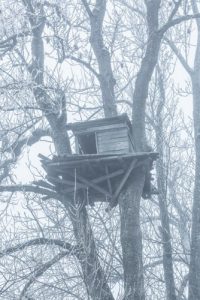
The outer ward, which initially housed the stables, shops and reserves of the castle, now houses an installation by Japanese artist Tadashi Kawamata. Born in Tokyo in 1953 and internationally recognized, he has made wood his material of choice. His in situ work, suspended in the trees, is emblematic of the artist's work: through improbable constructions, he changes our perception of the place and invites us to experience it in a different manner.
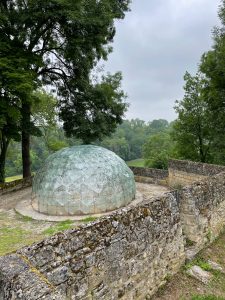
Glass held no secrets for this famous designer of bottles for the greatest perfumes. His "yurt", made from sheets of thermoformed glass, can serve as a poetic setting, and breaks free from the small size of the bottles he used to work with.
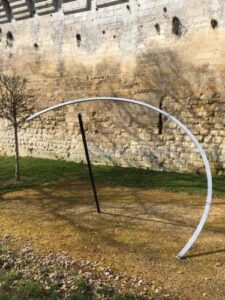
Patrick Fleury is an artist born in 1951. He divides space to give a new dynamic – both internal and external – to his artworks. The Arc Large reshapes the classical form of a sundial, with a modern touch.
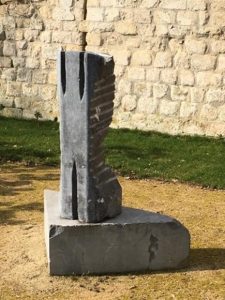
After meeting Brancusi, Dodeigne formulated the necessity of transmitting the stone’s energy, the tension between surface and volume. He declined it in his expressive and figurative sculptures, representing what is visible. With its stripped aesthetics and sacred aspect, Untitled (1997) is reminiscent of a memorial from a primal civilisations, whose presence and symbolic power still remain.
We know César for his famous Compressions, which were created with a hydraulic press and were an expression of randomness ordered by a renewed sculptural gesture. The 6 bronze pieces of his 1991 Expansions, are lesser-known. Expansion N°1, Grosse Ronde, shows the contrast of the form’s softness and the medium’s roughness. This random creative process is added to the one transforming materials with time, ultimately making it a living artwork.