
From the Middle Ages, to today
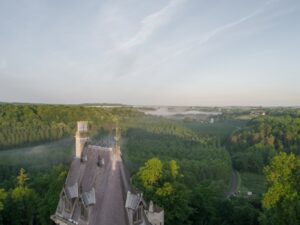
In the 16th century, Vez’s strategic and geographical importance put it at the center of all conflicts: the castle was first caught between the armies of Charles V, emperor of the Holy Roman Empire and then the most powerful European sovereign of his time, and those of François I, King of France. Later on, Vez once again found itself caught in the fighting between Catholics and Protestants during the Wars of Religion…
Vez then had multiple owners in the 17th and 18th centuries, until its noteworthy acquisition in 1890 by Léon Dru. Léon Dru was a civil engineer and a great industrialist. Thanks to his wealth, he restored Vez’s feudal attributes: he restored the entire castle, the chapel, the dungeon, and the then completely ruined ramparts, which had been dilapidated during the 18th century. He also had the roofs rebuilt following the recommendations of Viollet-le-Duc, a great specialist of the Middle Ages, while asking one of his contemporaries, Gustave Eiffel - most famous for building the Eiffel tower - to build the metal frame of the chapel. Again, make sure you check it out when you visit the Chapel.
In 1918, once more, the location served as a military defence: General Mangin summoned his staff there before the second battle of the Marne, and it was in Vez that he gave the order for one of the attacks that proved decisive to the Allied victory in World War I.
In 1987, the castle was bought by the Briest family. Ever since, the family has undertaken to combine these medieval stones with the art of the twentieth and twenty-first centuries, perpetuating the spirit that animated Léon Dru when he also called upon his contemporaries to bring Vez back to life.
Find out more
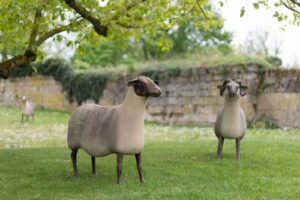
Here is another animal sculpture by François-Xavier Lalanne.
During the Middle Ages, sculptures representing natural elements or animals would be found on columns of religious buildings, as well as on portals, and gates. Many manuscripts also contained beautiful illustrations of plants or animals. Agricultural books, for example, would illustrate domestic and farm animals, such as chickens or pigs, and explain how to take care of them. Hunting manuals would illustrate wild animals found in the forest, such as boars or deers, and explain how to hunt them. The Bible itself often had many animal illustrations, the most important being that of the story of Noah’s Ark. And then of course, there are Esop’s fables, in which animals interact and act just like humans. Lalanne’s sheep are here to remind visitors of this long standing and ancient tradition of representing nature through art, which was particularly important during the Middle Ages.