
Defensive fortifications
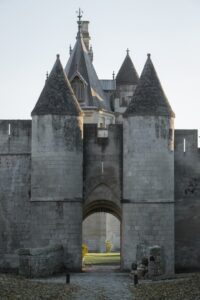
The enclosure of the dungeon is protected by ramparts that are approximately 13 meters high. The gate of the castle, which adjoins the dungeon, is the most important fortification, because it is the most easily taken by the enemy. It is located in the middle of a curtain wall, and is defended by two bell-turrets, and formerly by a drawbridge. A moat separated the perimeter wall from the poultry yard. Two additional turrets, built at the ends of the curtain walls, were also used for defense. One collapsed in the 1950s, and the other, still visible, is on the corner of Cour Bourdelle. There are many archer slits around the door, so that archers could protect the facade from a frontal attack or a siege.
Find out more
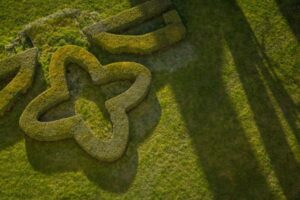
In 1990, the famous landscaper of the Tuileries garden Pascal Cribier created a minimalist garden for the Donjon de Vez, which revisits the medieval iconography and the tradition of the walled garden. Quatrefoils plants, emblematic forms of the Middle Ages, mingle with bouquets of gaura, evoking medieval “thousand flowers tapestries”. The organization of the vegetation, based on a set of levels, reminds us that in the Middle Ages perspective has not yet been conceptualized: it was simulated by variations of volumes and inverted heights, from a top-down perspective. Classified "Remarkable Garden" by the French Ministry of Culture, it is one of the few contemporary gardens to benefit from this label.
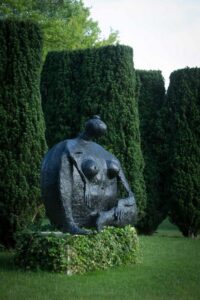
In front of you stands a bronze sculpture made in 1994 by French artist Robert Couturier. Trained by Aristide Maillol, Robert Couturier creates works with full, round and generous shapes. After World War II, the artist sought suggestion more than representation. He favours the line over modelling, around the eternal theme of the nude.
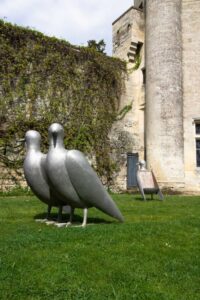
If you have listened to the previous points, you will surely have guessed the author of these animal sculptures. These are works by François-Xavier Lalanne, who here reinterprets the theme of birds by giving them a seat function, which paradoxically nails them to the ground. Once again, Lalanne marries aesthetic and utilitarian functions in his art.
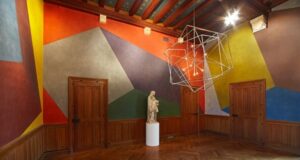
The dungeon houses a work by the American artist Sol Lewitt, the Wall Drawing, created in 1995 and spanning the four walls of the ground floor. Born in 1928, Sol LeWitt revolutionized the art scene of the 1960s, with a radical practice aimed at reducing shapes and colors to their simplest form. This concept of cleansing the shapes results in a geometrisation of the pattern and a range of tones limited to primary colors only. With this in situ work, the artist returns to the tradition of Renaissance murals.